

About Emily
Emily Lewis-Pinnell helps organizations close the gap between AI ambition and AI execution. As founder and CEO of Evaila, she works with leadership teams to redesign workflows, build governance structures, and drive adoption that changes how teams actually work, not just what tools they use. Her thesis is direct: the model is not the hard part. The workflow is. Most organizations stall not because they chose the wrong platform, but because they never changed how work gets done. Emily's CHART Framework (Clarify, Highlight, Architect, Ready, Track) gives leadership teams a structured path from opportunity identification through sustained adoption, with clear ownership at every phase. Before founding Evaila, Emily spent two decades building and scaling global cloud, data and AI service businesses. At NTT DATA, she was the first public cloud practice lead and advised Fortune 500 enterprises on their most consequential technology shifts. At Dell Technologies, she held senior strategy and go-to-market roles across infrastructure and services. That operating background, building practices from the ground up, managing P&Ls, and leading large cross-functional teams, shapes how she approaches AI adoption: as a business transformation challenge, not a technology procurement exercise. Emily is a Forbes Technology Council member and regular contributor, with bylines on AI ownership, shadow AI, workforce enablement, the augmentation-versus-automation debate, and scaling enterprise AI adoption. She speaks at events including SXSW, Chief AI Forum, SocialHRCamp, and VixulCon, and has been featured in CIO Magazine, InformationWeek, CIODive, and the Hampton Global Business Review. She also co-founded Hesvara, an AI-powered administrative platform helping family caregivers organize and manage records and advocacy. She holds an MBA from the Wharton School and a BA from Stanford University.
Speaking topics
Thought leadership
View all → Article
New research from Anthropic, OpenAI, and Wharton reveals that the strongest AI results come from better human-AI collaboration, not more delegation, and why that reframes the entire adoption conversat
 Article
As AI moves from experimentation into core operations, leadership teams must rethink ownership, shifting from a single-department model to shared decision rights across strategy, governance, adoption,
 Video
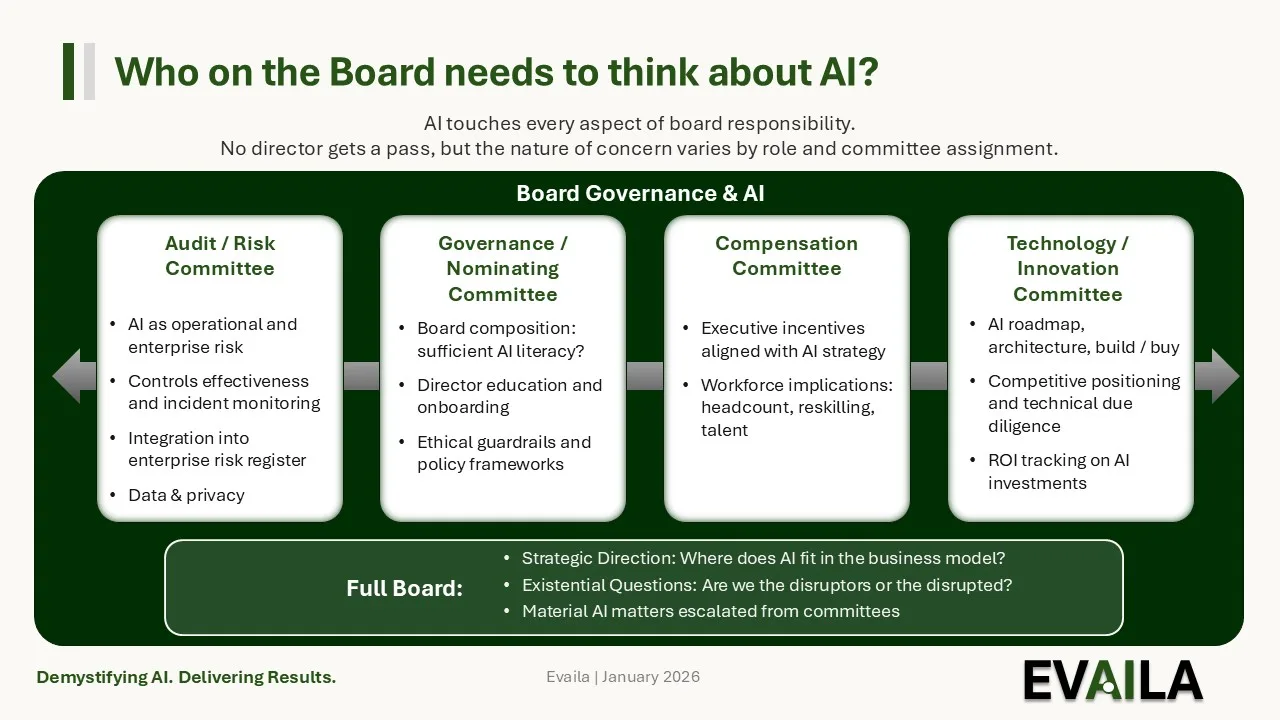
VideoHow boards should approach AI and why shared responsibility across all directors, not just the tech expert, is the governance gap most organizations haven't closed.
 Panel
PanelAI infrastructure decisions are reshaping energy markets, grid capacity, and capital strategy. Here's what business leaders need to know about the build-out happening beneath the surface.
Contact Emily
Share a few details about your event, project, or media inquiry. Your note goes straight to Emily, who replies to you directly. There's no agency in between.